← Jiamu Tang · Publications

CHI 2026 · Research walkthrough

Capability at a Glance

Design guidelines for intuitive avatars communicating augmented actions in virtual reality.

Human–Computer Interaction Virtual Reality Avatar Affordance Jiamu Tang · Yang Lu · collaborators
The central question

How can an avatar make an augmented capability—and the action that triggers it—understandable at a glance?

01 · Motivation

Augmented actions break familiar expectations
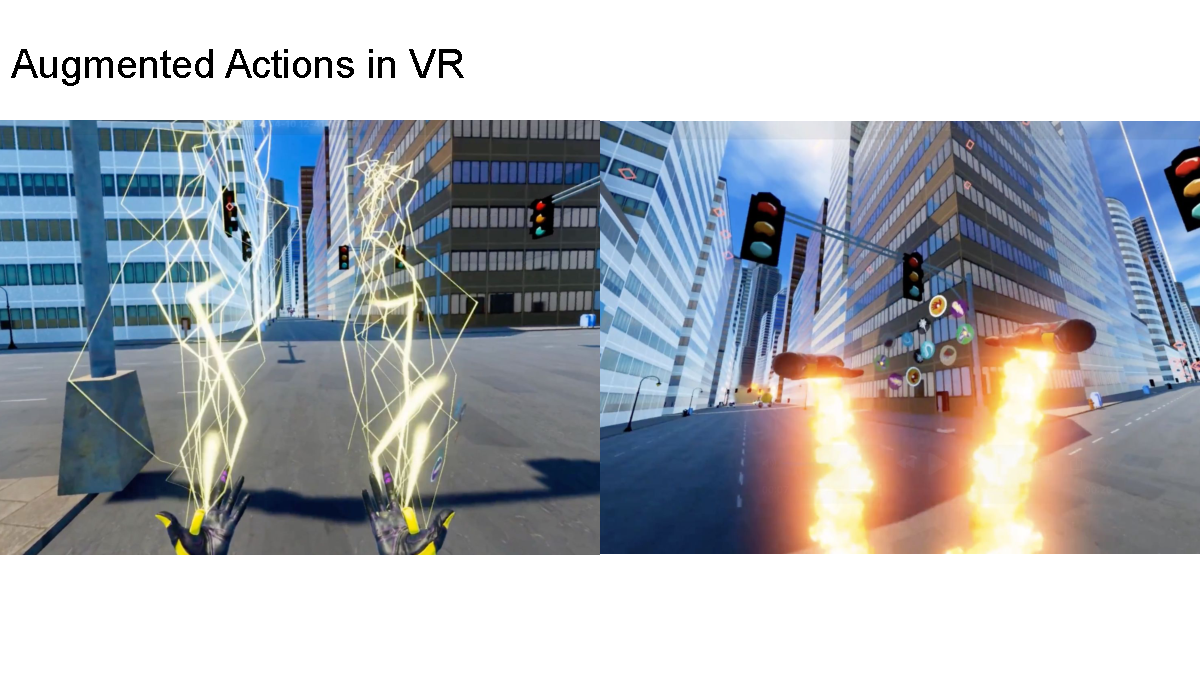
Examples of augmented actions in virtual reality, including electrical powers and fire propulsion
Reading noteVirtual reality can give people actions that have no everyday physical counterpart: launching from the ground, manipulating gravity, or producing electricity. Those powers expand what a user can do, but they also make it harder to infer what an avatar is capable of and how to activate that capability.
02 · Design problem

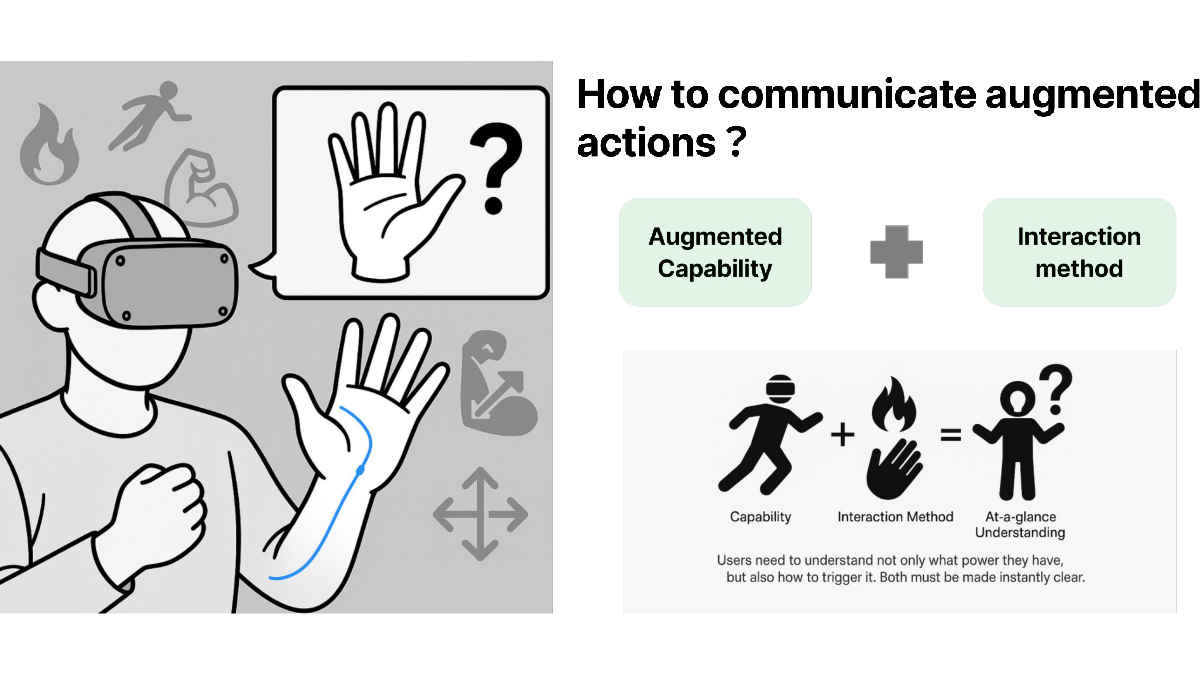
Capability and interaction must read together

Diagram showing the need to communicate both an augmented capability and its interaction method
Reading noteCommunicating a superpower is only half the problem. Users also need to know what gesture or body action triggers it. An intuitive avatar therefore couples a visible capability cue with an equally legible interaction cue, turning appearance into an at-a-glance instruction.
03 · Core principle

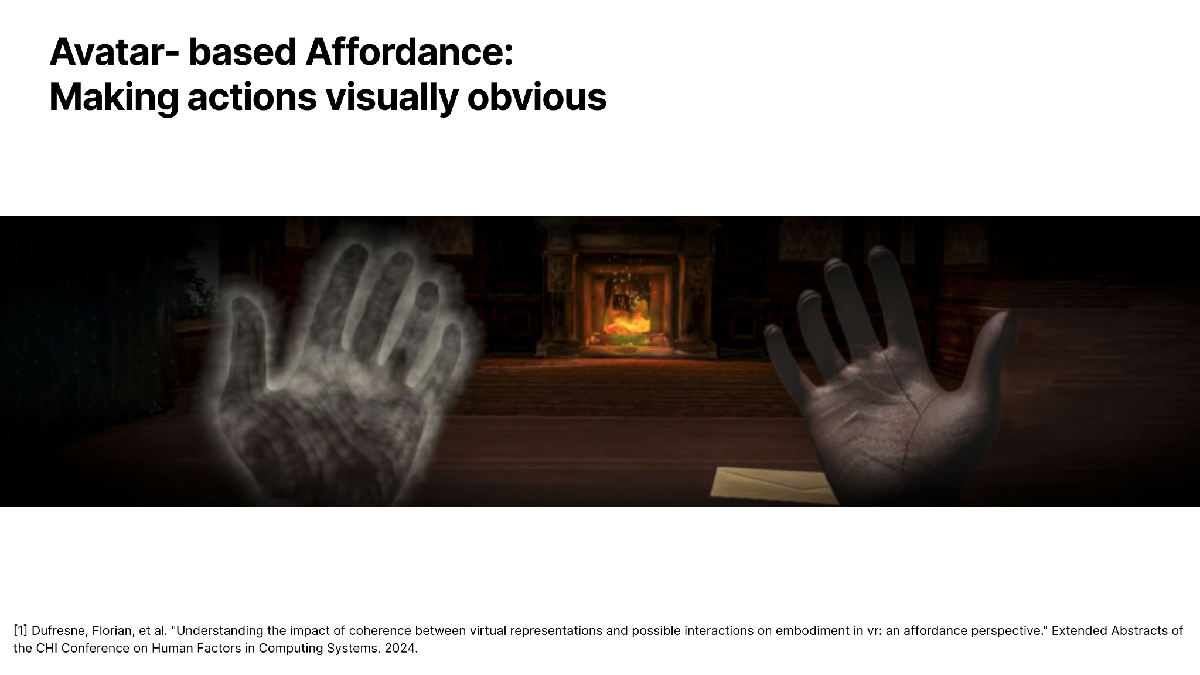
Avatar-based affordance makes action visually obvious

Avatar-based affordance example in which glowing hands signal an available fire interaction
Reading noteThe project treats the avatar itself as an affordance. Coherent visual features—such as glowing hands for fire control—can connect appearance, capability, and possible interaction before a tutorial or prompt is needed.
04 · Bird example

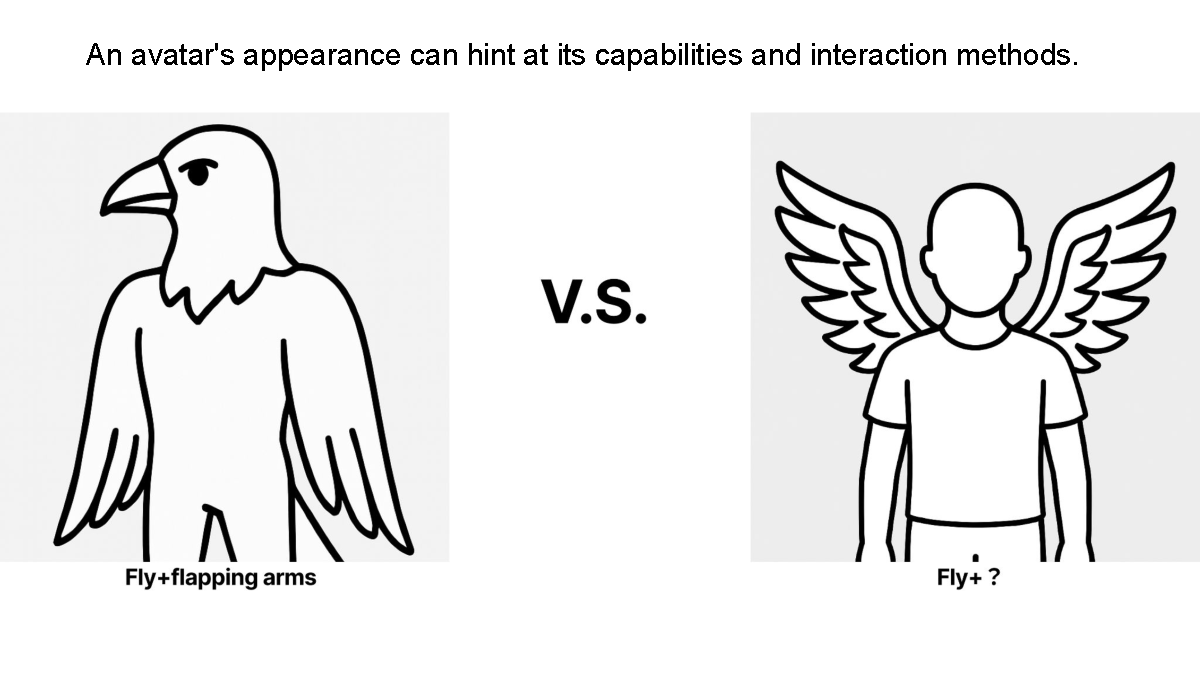
Appearance can reveal both power and gesture

Comparison between a bird-like avatar with wing arms and a human avatar with wings
Reading noteBoth avatars suggest flight, but only the bird-like body makes the interaction legible: its arms are wings, so flapping them is an intuitive trigger. Adding wings to an otherwise human body communicates the capability while leaving the required gesture ambiguous.
05 · Taxonomy

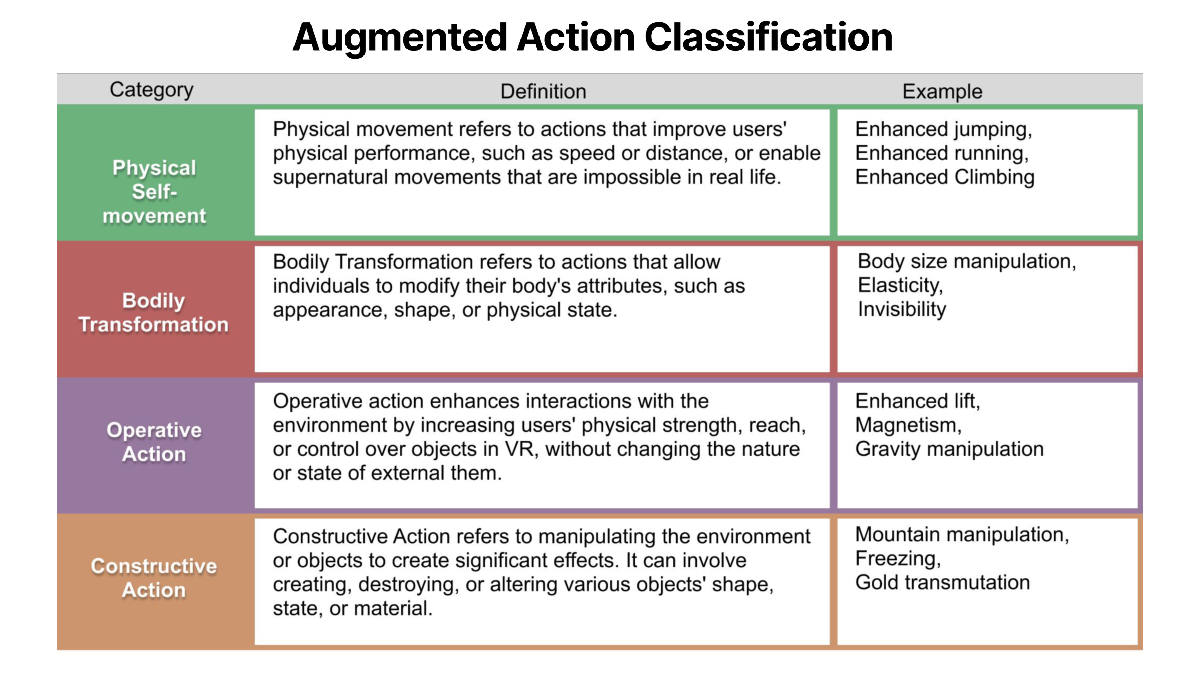
Four families organize augmented action

Classification of augmented actions into physical self-movement, bodily transformation, operative action, and constructive action
Reading noteThe design space is divided into physical self-movement, bodily transformation, operative action, and constructive action. The categories distinguish whether a power changes movement, changes the body, operates on another object, or constructs and alters the environment.
06 · Synthesis

Designer concepts become reusable guidance

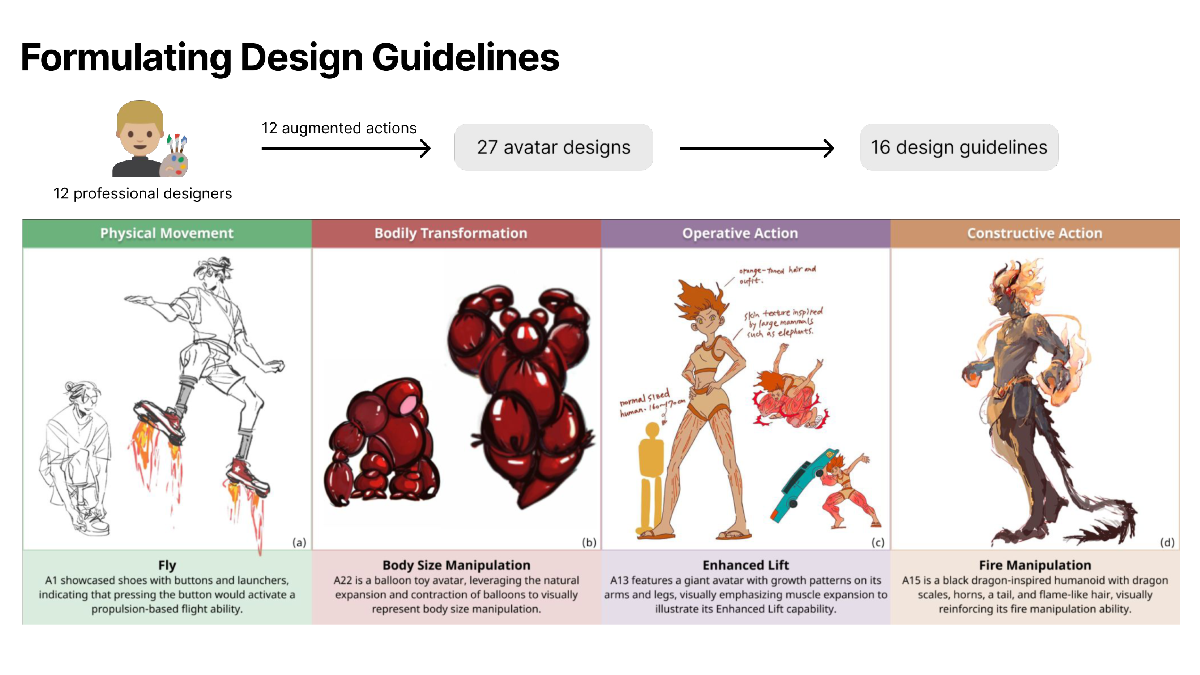
Process in which 12 professional designers create 27 avatar designs that are synthesized into 16 guidelines
Reading noteTwelve professional designers explored twelve augmented actions, producing twenty-seven avatar concepts. Comparing those concepts across the four action families yielded sixteen guidelines that preserve creative variety while making the underlying cues repeatable.
07 · Design guidance

Use familiar cues without collapsing creativity

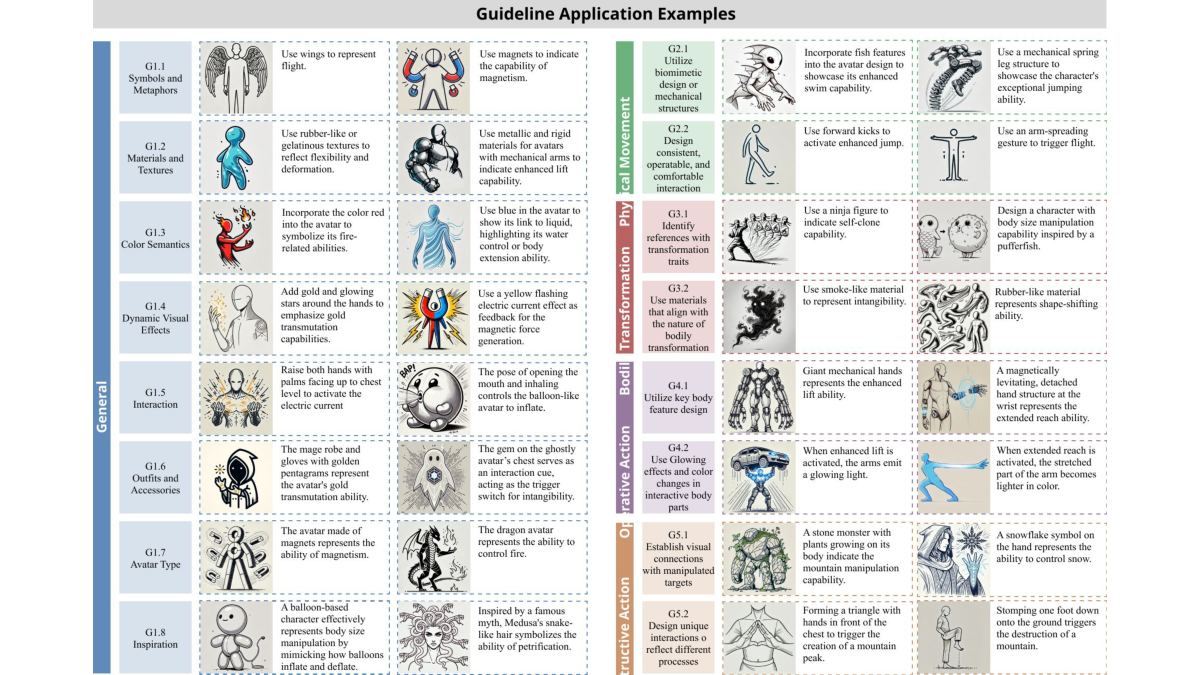
Illustrated examples of avatar design guidelines using symbols, materials, color, motion, body features, and interaction cues
Reading noteThe guidelines work as a vocabulary rather than a single visual style. Symbols and metaphors, material and texture, color semantics, dynamic effects, body structure, clothing, and gesture can all communicate capability—provided that the cue and the trigger stay coherent.
08 · Validation

Guideline-led avatars are easier to understand

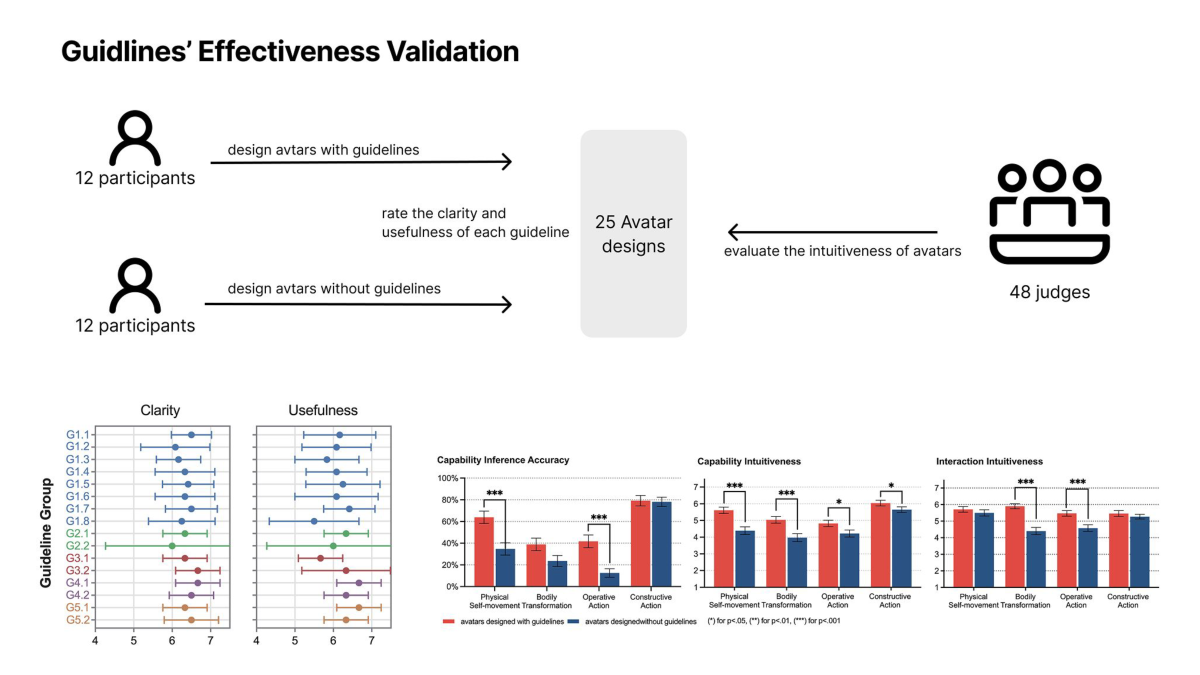
Validation study comparing avatars designed with and without the guidelines
Reading noteTwenty-four participants designed twenty-five avatars, while forty-eight judges evaluated their intuitiveness. Across the action categories, guideline-led designs improved capability inference and perceived intuitiveness, with the strongest differences appearing where body form and interaction cues carried the action.
09 · Applications

One framework, many forms of embodied action

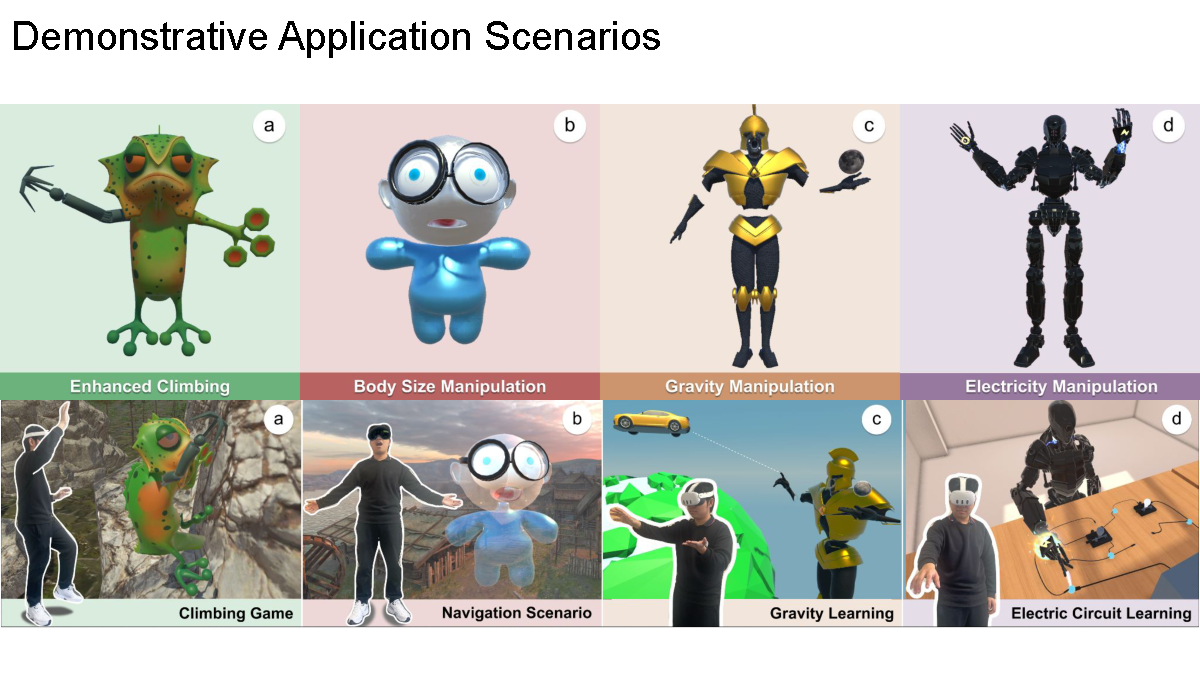
Four avatar applications for climbing, body-size navigation, gravity learning, and electric-circuit learning
Reading noteThe framework extends from entertainment to learning: enhanced climbing, body-size manipulation for navigation, gravity manipulation, and electricity control. The common thread is immediate comprehension—the avatar previews both what is possible and how the body participates.